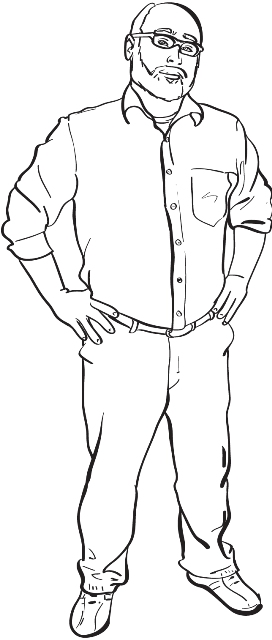
| Brad Fortier studies why humans behave the way they do, and uses that understanding to change how teams, organizations, and communities work together. He is a cultural anthropologist, a thirty-year improviser, and a facilitator who has built equity education and organizational development inside a state health authority, a public benefits nonprofit and a national food bank. His work has taken him from refugee communities in the US and EU, to the United Nations in Geneva, to boardrooms at Nike and Logitech. His clients and partners include: Nike | Logitech | OHSU | CareOregon | Oregon Health Authority | Oregon Humanities | University of Oregon School of Law | Oxford House | Jackson County Connect |
His Work
His method is applied improvisation. His lens is cultural anthropology. The two together produce a simple claim that most team-building gets wrong: groups do not become communities by being told to trust each other. They get there in an order. Familiarity, then routine, then trust, then community. Skip the first two and the fourth never arrives.
Brad has spent nine years building equity education and organizational development inside mission-driven institutions. Most recently he was Assistant Manager of Equity and Racial Justice Education at Oregon Food Bank, leading curriculum and eLearning at national scale with Feeding America. Before that he was Senior Equity Training and Education Coordinator at Uplift Oregon, where he launched the Oregon Peer Equity Network. From 2016 to 2021, at the Oregon Health Authority’s Office of Equity and Inclusion, he created and launched the agency’s DEI Training Strategic Plan and built its health equity curriculum; in 2020 he led the training team for Oregon’s COVID contact tracing rollout.
In 2016 he advised the United Nations Institute for Training and Research in Geneva on bringing experiential methods into their work. He served eight years on the board of OHSU Family Medicine at Richmond, a federally qualified health center, moving from patient member to vice-chair to chair.
He has been performing improvised theatre since 1996 and teaching it since 1998, to roughly three thousand people across the US, Canada and the EU. His work has gone into refugee communities in the US and EU, into design and disaster-response teams, into healthcare systems across Oregon, and into boardrooms at Nike and Logitech. Other organizations he has worked with include Legacy Health, OHSU, CareOregon, Oregon Humanities, Portland State University, the University of Oregon School of Law, Oxford House, Jackson County Connect, Rotary Youth Leadership Awards and the City of Lake Oswego.
He holds an MA in Interdisciplinary Studies from Portland State University, where he researched the neuroscience and social psychology of improvised theatre, and a BS in Anthropology. His chapter “Creating a Spontaneous Village: Community from Play” appears in *Applied Improvisation* (Bloomsbury, 2018), and he is the author of *A Culture of Play* and *Long-Form Improvisation*. He has presented at the Forum on Workplace Inclusion, the ATD Conference, and Applied Improvisation Network conferences in New York and Amsterdam.
He is at work on *Building Us: Improvising Our Way Home* with Robert Dassie.
What you can hire Brad for
- Keynotes and symposium talks (45–90 minutes)
- Executive team workshops and leadership seminars (half-day or full-day)
- Culture change consulting and long-term organizational engagements
- Creative facilitation for strategic sessions, design sprints, and visioning
- DEIJ-integrated team programming


So well put . . . you’re so friggin’ smart, Brad.
LikeLike
Without my having read the book, I’m curious as to whether you have done anything to tie improv into Erving Goffman’s “Presentation of Self in Everyday Life.”
Martin Dodge
Funtime Improv & Improvacateurs
LikeLike
Martin, you don’t even have to read the book. You can see it incorporated in this post: https://bradfortier.com/2011/01/12/on-the-road-to-a-new-ethnography-anthropology-improvisation-and-performance/
LikeLike
Dear Brad,
do you know of any empirical studies covering the field of improvisation, I mean quantative studies with any kind of data collection? I guess there are none, but you were recommended to me by the facebook worldwide-improvisers group being both an improv player and a scientist 🙂
THX!
Chris
LikeLike
Chris,
I do have some quantitative data regarding demographics of performers, as well as where and when people began learning improv. For the the demographics of performers N=65. For the info on when and where people learn N=75. Dan Goldstien is also a good person to connect with on this matter. He’s got a PhD in Psychology, and he gave me some scope on what sorts of psych research had been done. I think you should be able to access my thesis through the Portland State University Library. They have it in PDF format. It’s got way more detail and background, obviously, but it also has the distilled report of the performer demographics in the chapter “Performers”. I’d love to connect more with you about this.
LikeLike
Thank you! I’ve approached a Dan Goldstein who’s psychologist and improv player on facebook, hope he’s the right guy. I can send you my thesis when it’s finished, unfortunately it’ll be in german language but I’m gonna translate at least the abstract 🙂
LikeLike
You’re welcome. Drop my name if Dan is slow to respond. He’s a busy guy with a family teaching in London. I’ve got a lot of friends in Germany, and it’s about 90% likely that I’ll be coming through on a European teaching tour this June. Where are you at? Maybe we could meet for a chat if all goes well. Thanks for reaching out and sharing! Cheers.
LikeLike